Case Study: Lower Leg Pain in D-I Sprinter

Jon Maneen • September 29, 2022

Background: Division 1 sprinter has been experiencing intermittent calve pain for the past 3 months. She does not notice pain while sprinting but does have significant increase in pain when she slows down from a sprint as well as during slower steady state runs (warm-ups around the track). Pain is reported along anterior lateral lower leg, along with posterior medial lower leg on right. Pt had received radiographs within last 2 weeks and resulted in no signs of fracture.  


Goals: Return to competing 100m and 200m along with warm-ups without lower leg pain


Past Medical History : Stress fractures in B lower legs 2 years ago, multiple hamstring strains over the past 3 years.


Limitations: Only able to visit clinic 1x/week due to travel and school.

Objective measures:


  • Standing posture:
  • Flat foot (pes planus)
  • Over pronates with walking
  • Range Of Motion:
  • Ankle:
  • dorsiflexion 8 degrees B
  • plantarflexion, eversion, inversion within normal limits except with mild stretch pain at end range plantarflexion
  • ½ kneel dorsiflexion test: limited 1.5” from wall
  • Knee:
  • Normal flexion and extension
  • Hip:
  • Hip flexion: normal with mild pinching pain at end range
  • Extension: lacking 15 degrees of hip extension B
  • Mobility:
  • Talocrural joint: hypomobile
  • Big toe: 50% extension in neutral and dorsiflexed position.
  • Manual Muscle Testing:
  • 5/5 all planes and pain free
  • Single Leg heel rise:
  • Unable to perform 1 to full range and reported pain in posterior medial calve
  • Able to perform 18 on L
  • Special testing:
  • Bump test: negative
  • Fulcrum test: negative
  • Palpation:
  • Tenderness along medial gastroc head, tibialis posterior, tibialis anterior


At the first visit, since she was asymptomatic while performing her actual sport (100m & 200m), and she was advised to continue participating in sprinting during practice. Since she reported increased pain with steady state running during warm-ups, she was asked to either completely discontinue the warm-up run or modify to only running pain free distances, which resulted in 1 lap around the track.

I was able to watch and record her running mechanics within her first session, and she did demonstrate a few faults. The biggest breakdown in her running gait had been her increased stride length and backside mechanics. Since we decided together to limit her steady state running to only being pain free, we also wanted something to replace her warm-up lap.

To address her lower activity level along with improving her running mechanics, it was decided to use Mach-drills to fill the gap. These drills are intended to improve her arm action along with improving her front side mechanics which would result in an improved foot strike pattern.

Below you’ll find what each session entailed, along with progressions she was given on a weekly basis to work on. She never once stopped running track, and went on to have a successful, pain-free season.
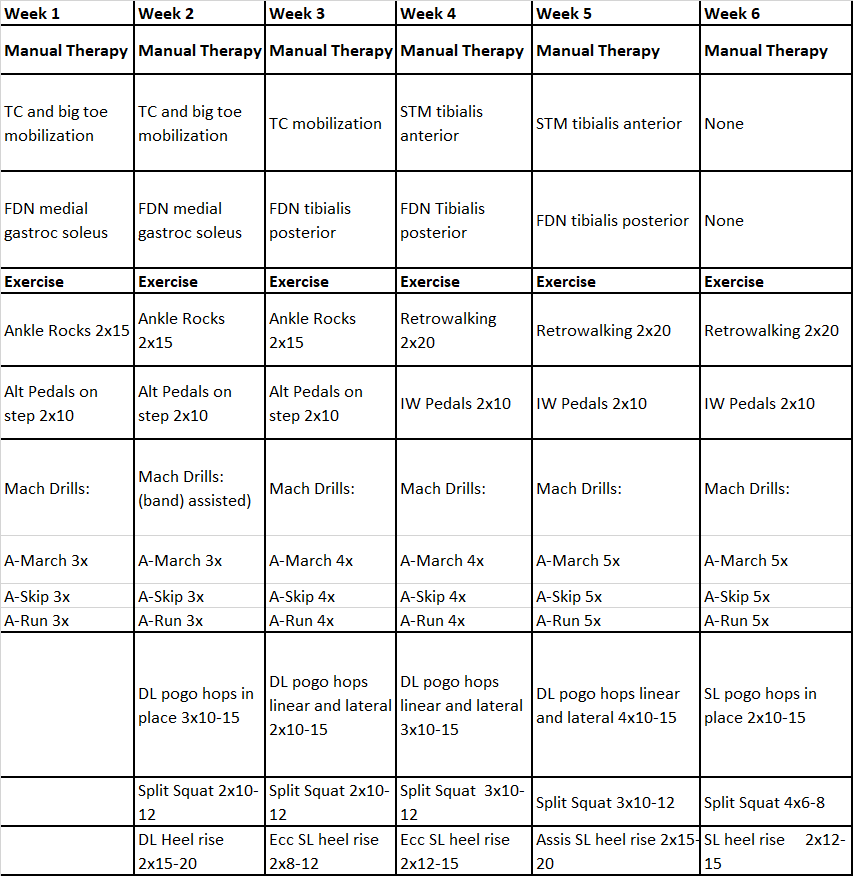
 

A list of exercises for a manual therapy program

Recent Blog Post

Hawkin Dynamics Jump testing
By Jon Maneen March 2, 2026
Watching the CrossFit Open always fires people up. Seeing athletes like Colten Mertens fly through workout reminds everyone what’s possible when movement, strength, and conditioning line up perfectly. This year’s Open starting with CrossFit Open 26.1, brought something familiar back into the spotlight: the box jump. It looks simple. Jump on a box. Step down. Repeat. But here’s what most people don’t realize: There are two very different kinds of box jumps — and they train two very different things. We see the confusion around this every week in the clinic, and actually spoke with a few different athletes about this very thing recently. Buckle up and let's dive in. Efficient Box Jumps vs. Box Jumps for power In CrossFit workouts, box jumps are usually there to test your engine. You’re trying to get through reps efficiently. That means shorter dips, quicker repetitions, and just enough jump to clear the box. The goal isn’t to jump higher, it’s to maintain your performance the workout. That’s totally fine, as long as you understand what you’re training.
By Dennis Brady October 30, 2025
Why Golf Is More Physical Than You Think
By Becky Cyr October 27, 2025
Understanding Cervicogenic Dizziness And How Physical Therapy Can Help
July 19, 2025
Discover the best PT strength and mobility exercises tailored for runners in Newington, CT. Improve hip mobility, core strength, glute activation, IT band flexibility, and more.
Runner on a paved path in a park, wearing blue leggings and white shoes; sunny day.
July 17, 2025
Discover how physical therapy supports beginner runners in Central CT training for their first half-marathon. Learn injury prevention tips, gait analysis, and more.
Show More
Hawkin Dynamics Jump testing
By Jon Maneen March 2, 2026
Watching the CrossFit Open always fires people up. Seeing athletes like Colten Mertens fly through workout reminds everyone what’s possible when movement, strength, and conditioning line up perfectly. This year’s Open starting with CrossFit Open 26.1, brought something familiar back into the spotlight: the box jump. It looks simple. Jump on a box. Step down. Repeat. But here’s what most people don’t realize: There are two very different kinds of box jumps — and they train two very different things. We see the confusion around this every week in the clinic, and actually spoke with a few different athletes about this very thing recently. Buckle up and let's dive in. Efficient Box Jumps vs. Box Jumps for power In CrossFit workouts, box jumps are usually there to test your engine. You’re trying to get through reps efficiently. That means shorter dips, quicker repetitions, and just enough jump to clear the box. The goal isn’t to jump higher, it’s to maintain your performance the workout. That’s totally fine, as long as you understand what you’re training.
By Dennis Brady October 30, 2025
Why Golf Is More Physical Than You Think
By Becky Cyr October 27, 2025
Understanding Cervicogenic Dizziness And How Physical Therapy Can Help
July 19, 2025
Discover the best PT strength and mobility exercises tailored for runners in Newington, CT. Improve hip mobility, core strength, glute activation, IT band flexibility, and more.
Runner on a paved path in a park, wearing blue leggings and white shoes; sunny day.
July 17, 2025
Discover how physical therapy supports beginner runners in Central CT training for their first half-marathon. Learn injury prevention tips, gait analysis, and more.
A man is sitting on a park bench with his head down.
By Jon Maneen June 23, 2025
Expert physical therapy in Newington, CT for athletes of all levels. Rebound Performance PT offers specialized treatment for sports injuries, return-to-sport programs, and more.
A woman is getting her elbow examined by a doctor.
May 1, 2025
Learn how structured rehab phases can speed your recovery while preventing reinjury. Discover the science behind proper tissue loading and practical strategies you can apply today.
A man and a woman are running in the woods.
By Jon Maneen April 15, 2025
Improve your running performance with expert-recommended strength & mobility exercises. Get guidance from Rebound Performance PT.
A woman is running on a brick path in a park.
By Jon Maneen April 15, 2025
Learn about common running injuries and how physical therapy helps in recovery. Get expert care with Rebound Performance PT.
A man is swinging a golf club on a golf course.
By Dennis Brady May 22, 2024
Improve your golf game with better hip rotation—learn why mobility matters and how physical therapy helps you generate more power with less injury risk.